
International Tourism Congress (ITC) is the annual scientific meeting of the Centre for Tourism Research, Development and Innovation (CiTUR).
CiTUR is a research and development (R&D) centre, composed by over 200 researchers from 17 portuguese institutions (polytechnics and universities) organized in 9 portuguese hubs and 2 international affiliated hubs, in Brasil and Ecuador.
CiTUR R&D focuses on fostering multidisciplinary and interdisciplinary applied research, and on stimulating the production and sharing of scientific knowledge in hospitality and tourism.
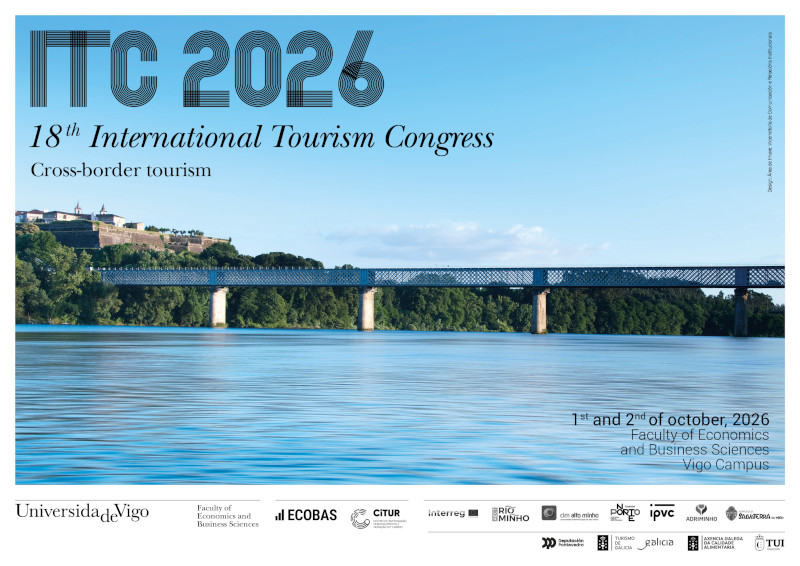
The 18th edition of ITC will take place from 1st to 2nd October 2026, hosted by the Faculty of Economics and Business Sciences of the University of Vigo.
Cross-Border Tourism
Theoretical Background for the International Tourism Congress 2026
The main theme of the congress is Cross-border tourism making ITC’25 an opportunity for academics, master and doctoral students to present and discuss national and international experiences on global development project through tourism.
ITC’26 is focused with the use tourism as a tool for sustainable development in Spain–Portugal border regions, integrating the circular economy, social economy, and family businesses, using The Minho as an example of a territory with a shared identity, family businesses in tourism, and circular experiences (gastronomy, river resources, routes, heritage), growing international interest in cross-border destinations as laboratories of sustainability.
The congress will bring together researchers in the different fields of sustainability in cross-border tourism, hospitality and catering, and invites all public administration members, businesses leaders, and professionals who want to discuss and share their experiences about the most recent trends in the field.
Therefore, the programme aims to be broad and inclusive, covering various areas of tourism and hospitality research, including contribution from multiple disciplines, such as economics, management, sociology, geography, cultural studies, environmental science, and technology, reflecting the complex and interdisciplinary nature of this field.